Seasonal Sunset Watches

It’s time for the seasonal sunset watch, every solstice and equinox sunset at Solstice Park in West Seattle. Here are the details for the next several events, times are Pacific:


# Date Event Time Expected Actual
Sunset Time
Official
Sunset Time
Equinox/ Solstice Moment Time
70 September Equinox 2026
Tuesday, September 22, 2026
6:30 pm – 7:30 pm 6:50-6:55 pm (trees)
7:00 pm (horizon)
7:07  pm 5:05 pm
71 December Solstice 2026
Monday, December 21, 2026
3:45 pm – 4:45 pm 4:05 pm (trees?)
4:14 pm (horizon)
4:20  pm 12:50 pm
72 March Equinox 2027
Saturday, March 20, 2027
6:30 pm – 7:30 pm 6:50-6:55 pm (trees)
7:12 pm (horizon)
7:22  pm 1:25 pm
73 June Solstice 2027
Monday, June 21, 2027
8:30 pm – 9:30 pm 8:50-8:56 pm (trees) 9:11  pm 7:11 am
  • When:

    • We have noticed that the Sun sets about 10-15 minutes earlier than the USNO‘s official prediction says, because of the horizon altitude. We use the PeakFinder app to determine exact sunset time, but I only use that the day of the event.
    • The moment of the solstice/equinox doesn’t usually happen during this event, but I list it here for you to know.
  • Where: Solstice Park – all the way up the hill from the tennis courts (or, if you’re not in Seattle, wherever you have a view of the western horizon!)
  • Who: Everyone welcome, as usual. Consider your health when making your decision to attend. (Please do leash your dogs as we usually have a good number of people, kids, and other dogs around.)
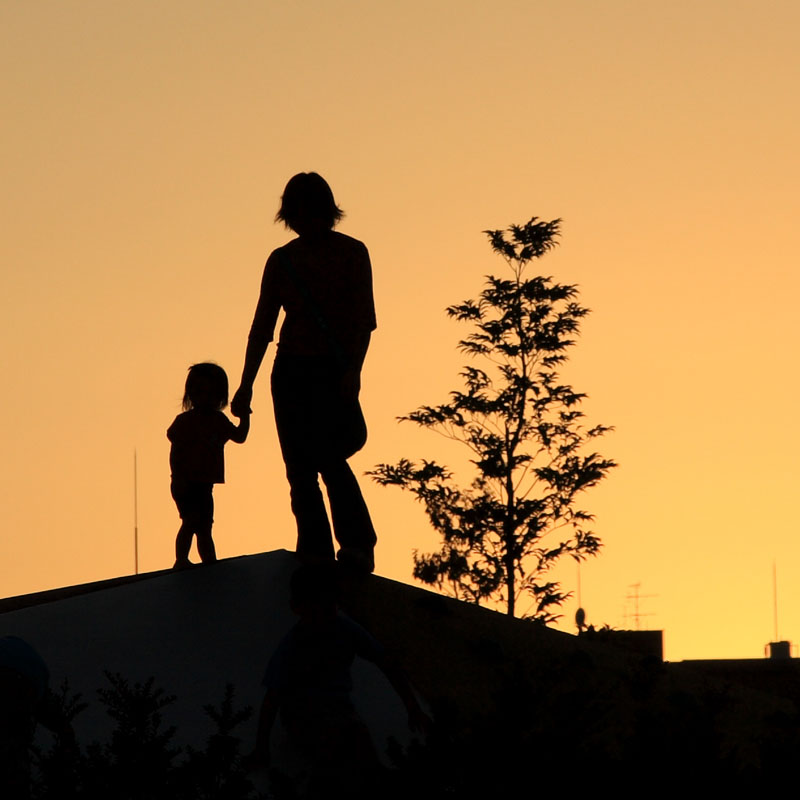
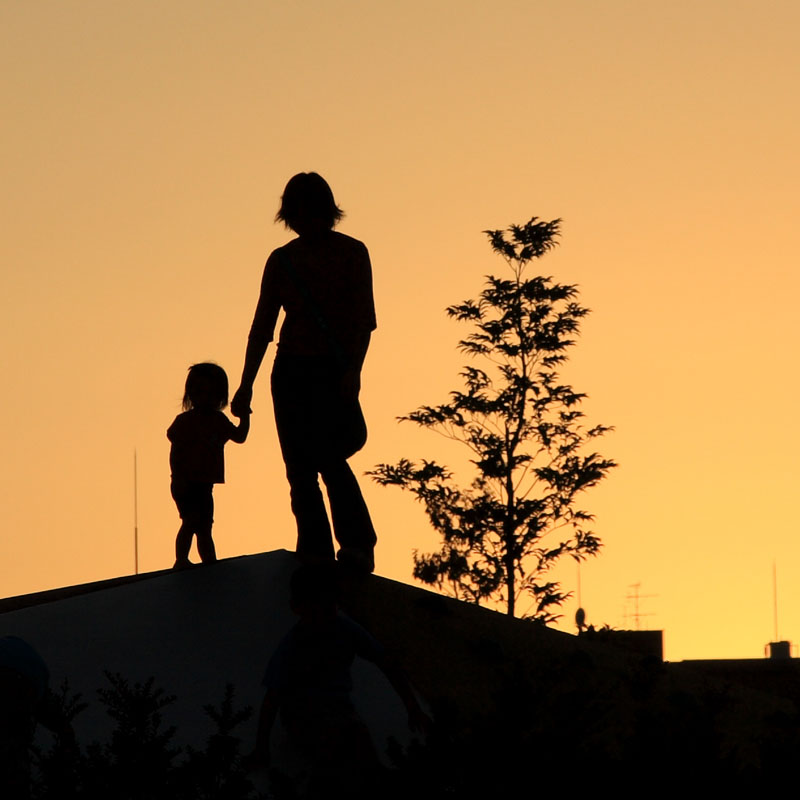
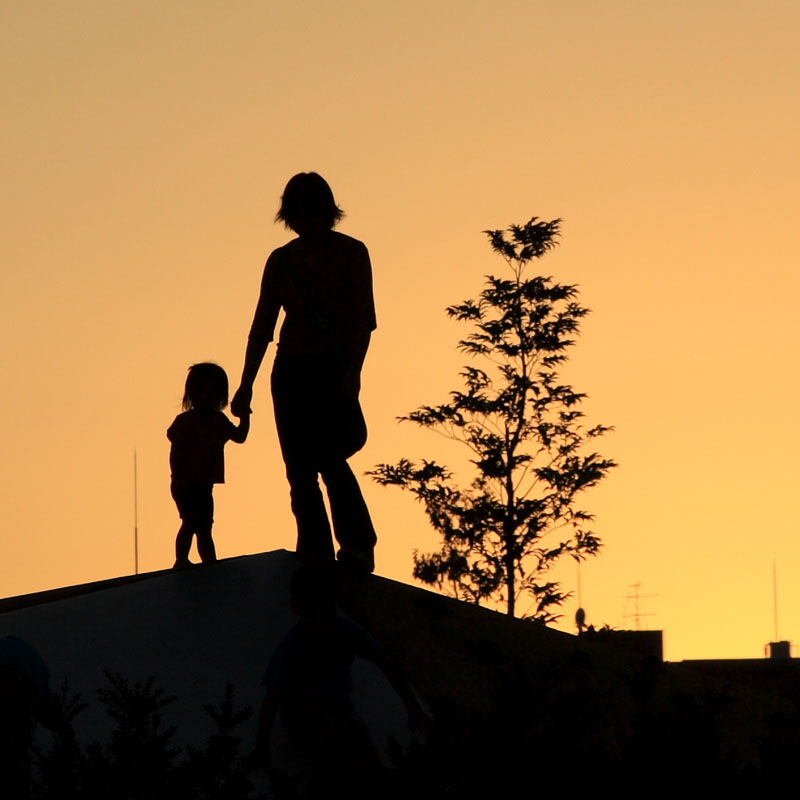
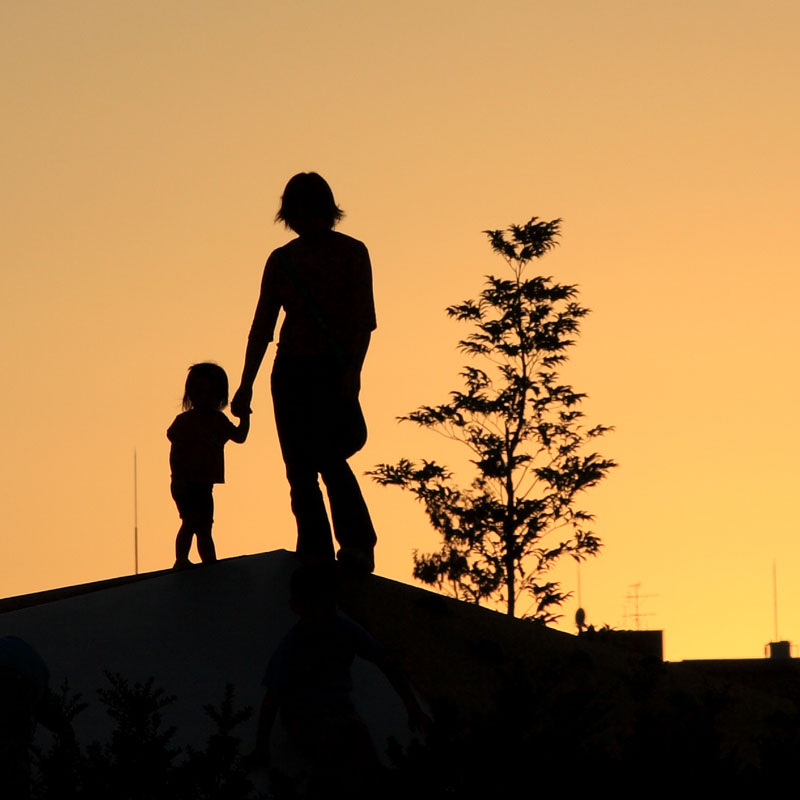
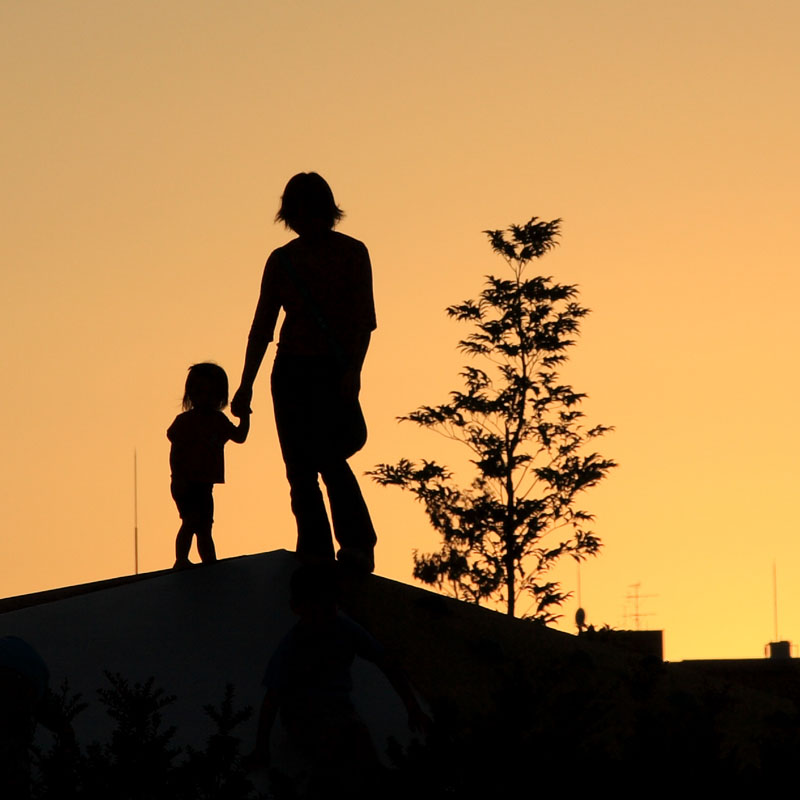
Parent and Child at Sunset by Kazuhiko Teramoto

Parent and Child at Sunset by Kazuhiko Teramoto, skyseeker

Come watch the sunset at Solstice Park in West Seattle. I’ll be there even if it is cloudy because sometimes the Sun peeks through just as it begins to set, but if it is driving rain or a thunderstorm I’m staying home with some tea!

If you’re interested – here’s the timing of various celestial events  from Seattle, courtesy of the U.S. Naval Observatory Astronomical Applications Department.

This event is my part of the NASA’s Solar System Ambassador program, and thanks to West Seattle Blog for publicizing all of them!

Everyone is welcome, see you there!

~ A l i c e !

Where Should You Go for Stargazing or to watch the Perseids?

See the tab above that says “Seattle Stargazing“? That’s my most recent list of ideas for you.

The map can be found over on Google Maps as well.

My Perseids news coverage 2015

-Full article at West Seattle Blog.

-Interview on KUOW’s The Record for 8/12/2015.

-365 Days of Astronomy What’s Up Tonight, Southern Skies Edition August 2015 (includes tips on astrophotography)

Alan Boyle’s article at GeekWire about Seattle stargazing spots

~ A l i c e !

Upcoming Nova in Corona Borealis

This summer, 2024, we are likely to have a unique opportunity. There is a star in the constellation of Corona Borealis that is going to go nova. This means it is going to get much brighter, and it will look like the constellation has a new star for a short period of time. The star is named T Coronae Borealis or the Blaze Star.
(Hint, don’t confuse it with τ Coronae Borealis).

After that, the star will dim back down to something you need binoculars to see, and then dimmer still so you’ll need a telescope again–as is true right now.

Lots of info about the nova: https://www.nasa.gov/centers-and-facilities/marshall/nasa-global-astronomers-await-rare-nova-explosion/

Published directions for how to find the Corona Borealis in the night sky suggest finding Hercules first—one of the most difficult to find because it is so dim. Let’s do something else.

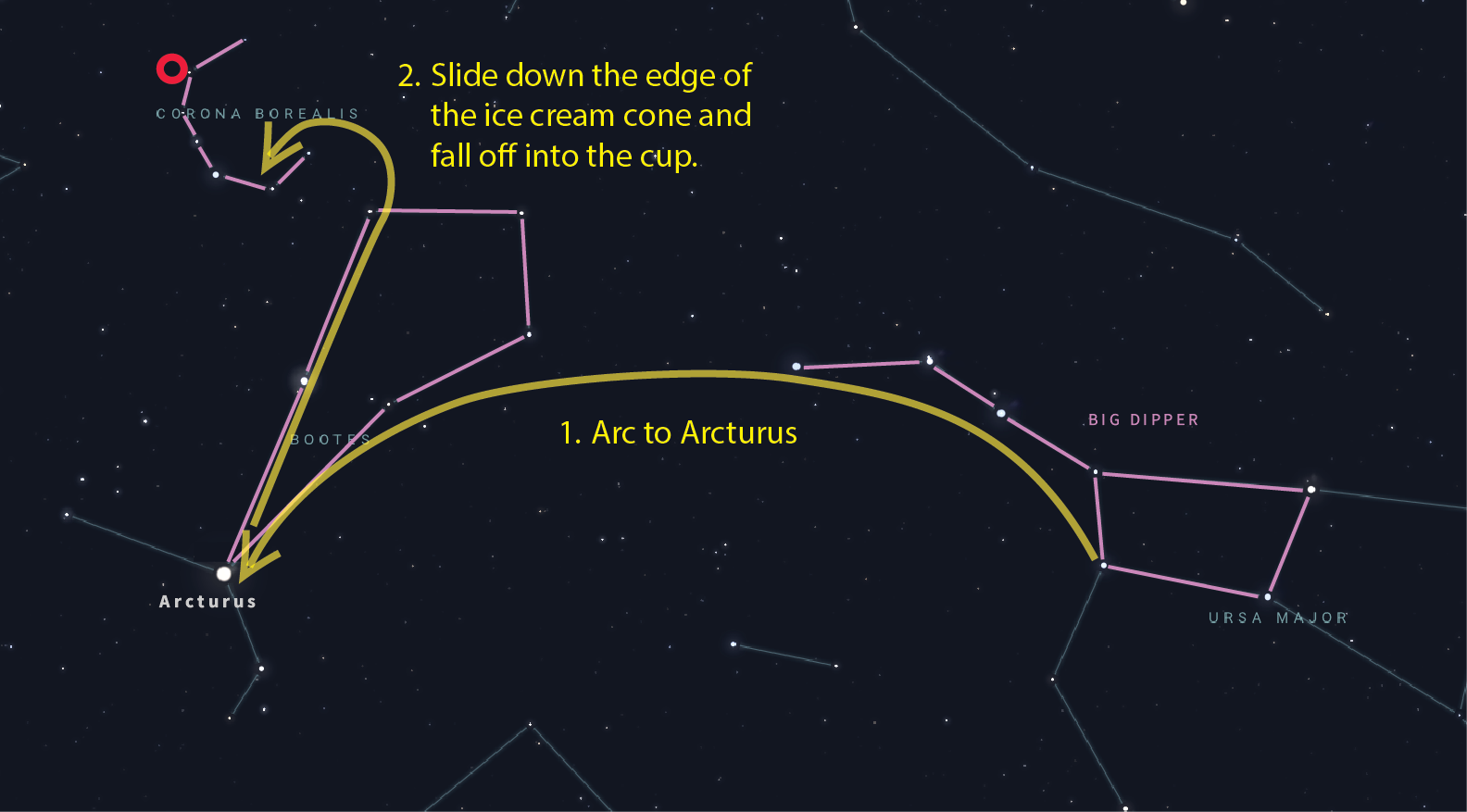
Corona Borealis itself is much easier to find. I suggest you use star hopping. Here’s how:

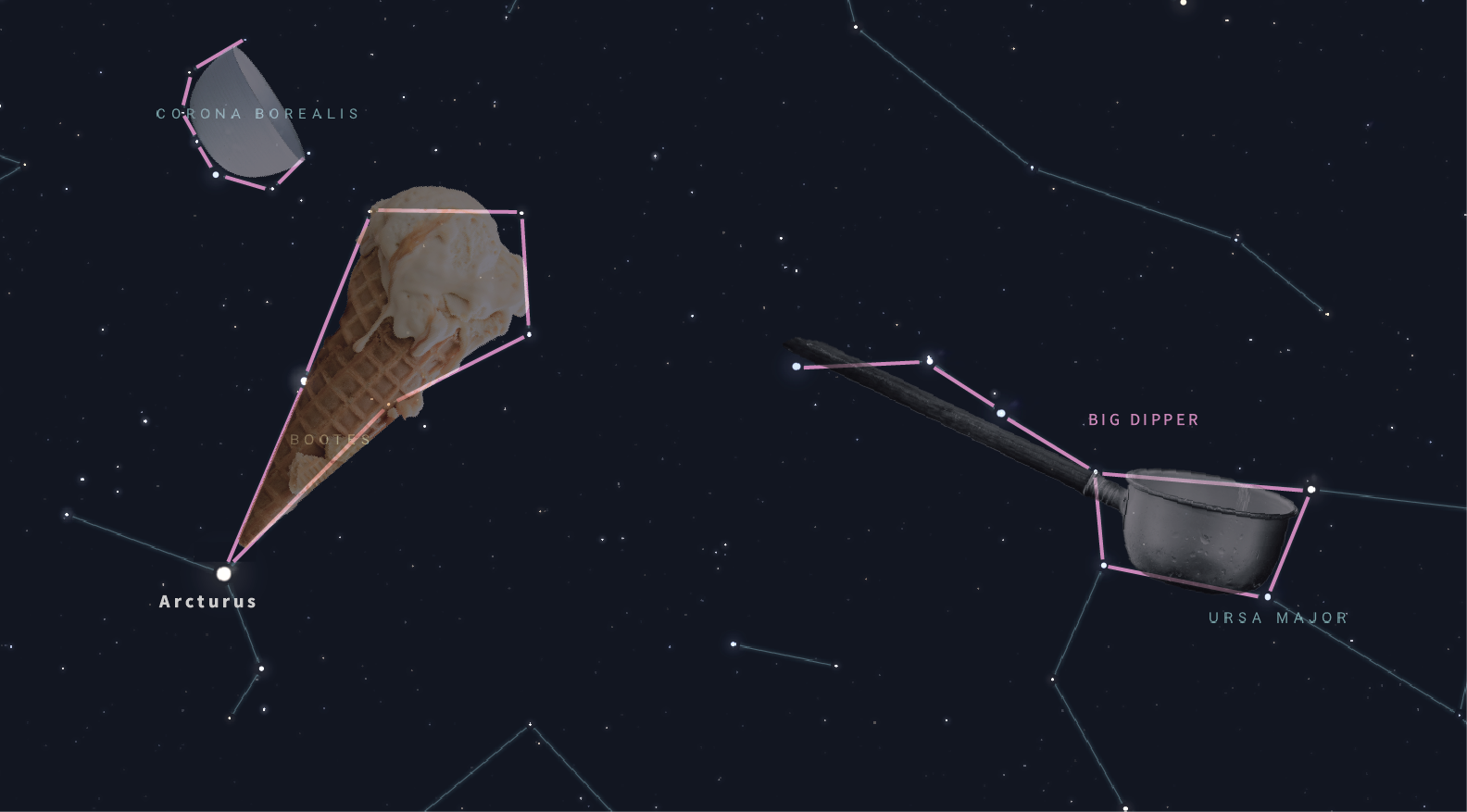
Star hopping directions for finding Corona Borealis. Big Dipper to Bootes to Corona Borealis.
  1. Start by finding the Big Dipper. I know that’s a big ask at first, but it is always in the North, and pretty big. Use a planetarium app on your phone to help find it the first time.
  2. Follow the arc of the handle of the Big Dipper and keep on going past the end in the same arc.
  3. Keep following that arc until you get to a bright star. This is (believe it or not) Arcturus. You have just “arced to Arcturus.”
  4. Arcturus is the base of a medium brightness constellation named Boötes, which is shaped like a mostly-eaten ice cream cone.🍦

    • A diagram of three constellations. The first is Corona Borealis matched with an image of a bowl. The second is Bootes matched with an image of an ice cream cone. The last is the Big Dipper matched with a ladle.
  5. Slide up the left-hand side and just sorta fall/flip off the end into the little cup of stars.
  6. 🎉Ta-Da! That little cup of stars is Corona Borealis!!!
  7. The nova, when it happens, will be off to the left.

Images by Alice Enevoldsen. Starfield from Stellarium. Photos from Unsplash: Ice cream cone – Dana DeVolk. Bowl – Tom Crew. Dipper – David Klein.

– Alice

Comet NEOWISE (C/2020 F3) from West Seattle

This comet is visible a couple hours before sunrise for the next few days (July 9, 10, 11) and shortly after sunset after July 12 or so. All dates and times I mention are for West Seattle, Washington, USA. We’re in Pacific Time and at latitude 47.5°. Most of the times will be approximately true for your local time if you’re between 30-50° latitude in the Northern Hemisphere.

The problem with Comet NEOWISE is, even though it is fairly bright for a comet, it is still very close to the Sun from our point of view. When the Sun is in the sky, or even not in the sky but near the horizon, the sky itself is bright, washing out dimmer stars and sky objects. So you have to find the balance point between the peak of the comet’s brightness (which seems to be today July 9) and its distance from the Sun in the sky. Starting July 12 it will get farther and farther from the Sun in our sky, and be visible later and later after sunset.

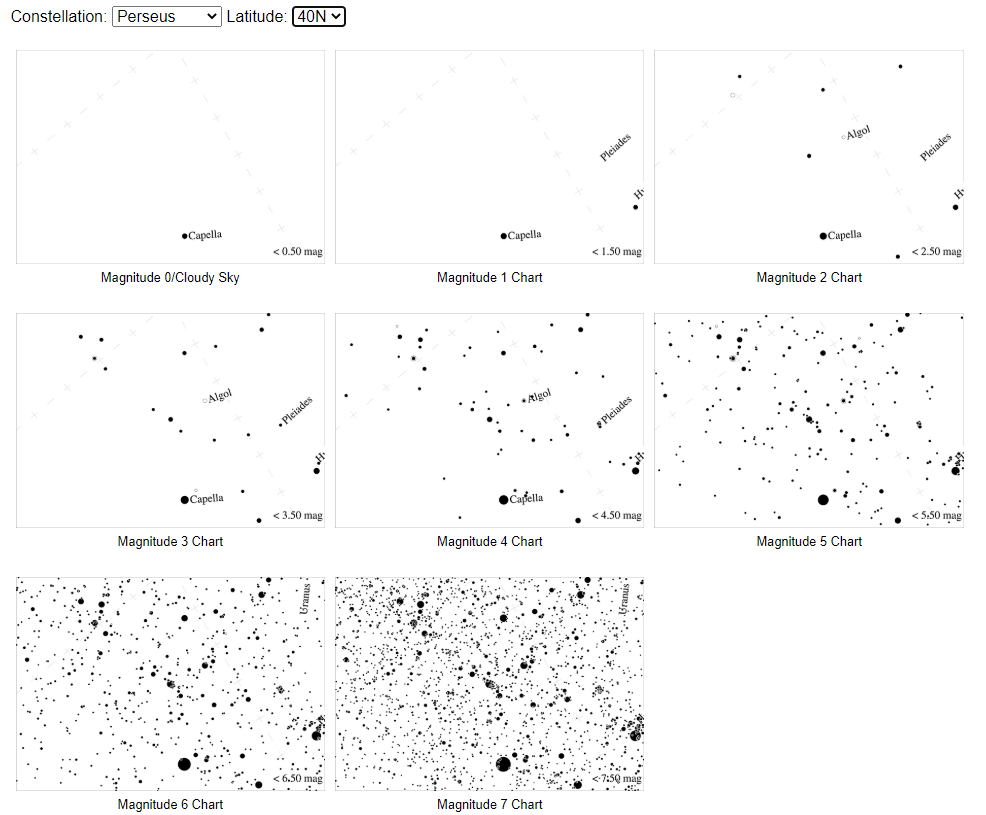
NEOWISE is currently approximately visual magnitude 2 (smaller numbers are brighter), which is easily visible in a semi-dark sky. You can use these star charts to estimate whether or not a magnitude 2 object will be visible where you are. If you can see as many stars as are in the magnitude 3 chart, or more, then the comet will be visible. If you’re reading this after July 10, check the current magnitude of the comet, and look for the chart for stars dimmer than that.

an image of 8 different sky maps showing different numbers of stars. Magnitude 0 shows only one star, Magnitude 1 shows a few. Magnitude 7 is very dense with stars.

Image from Globe at Night

Morning Sky

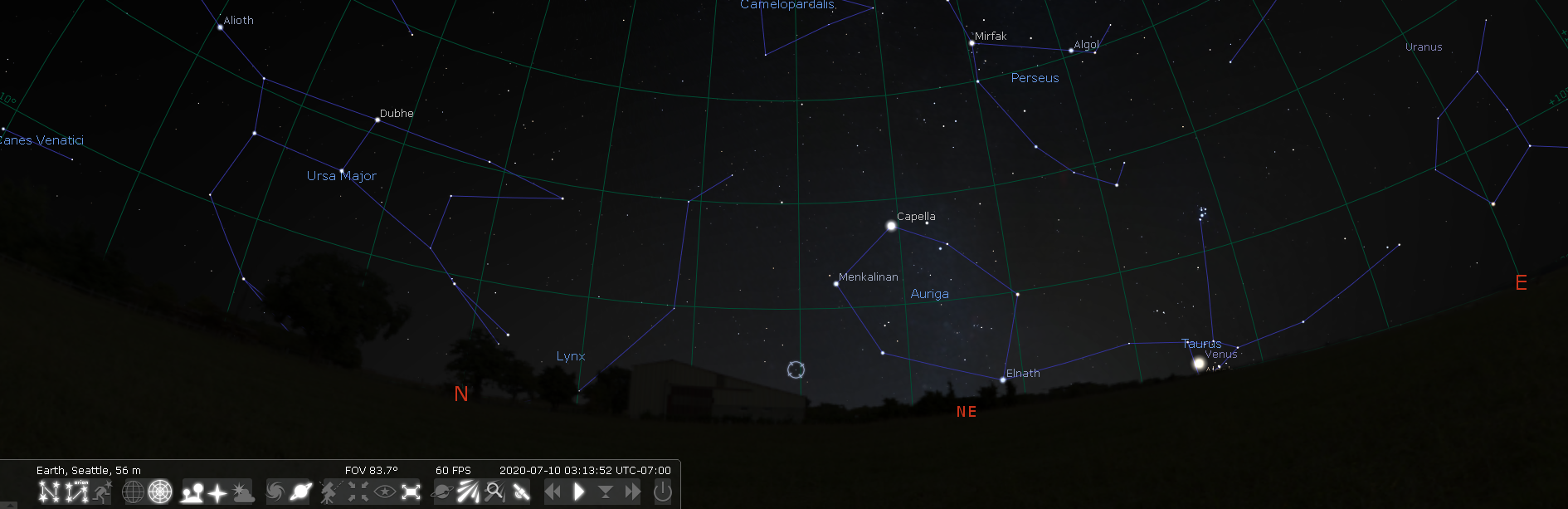
Your best chance for July 10 and July 11, 2020 will be around 3-3:40 am looking towards the Northeastern horizon.

a Seattle horizon view from Stellarium here for July 10th at 3am. It will show a small marker next to the Northeast horizon between the constellations of Auriga to the right/North and Ursa Major (the Big Dipper) to the left/South. The marker is about 1/4 of the from Auriga to Ursa Major, it is much closer to Auriga.

Image from Stellarium

The Northeast horizon is our worst horizon in West Seattle, because that’s directly over Seattle proper. Lots of light pollution. If you want to see this comet, you’ll have to go to the other side of the city. Consider the peninsula or the East side of the Cascades. Wherever you choose, please wear a mask and stay more than 6 feet away from stargazers who aren’t part of your household.

Evening Sky

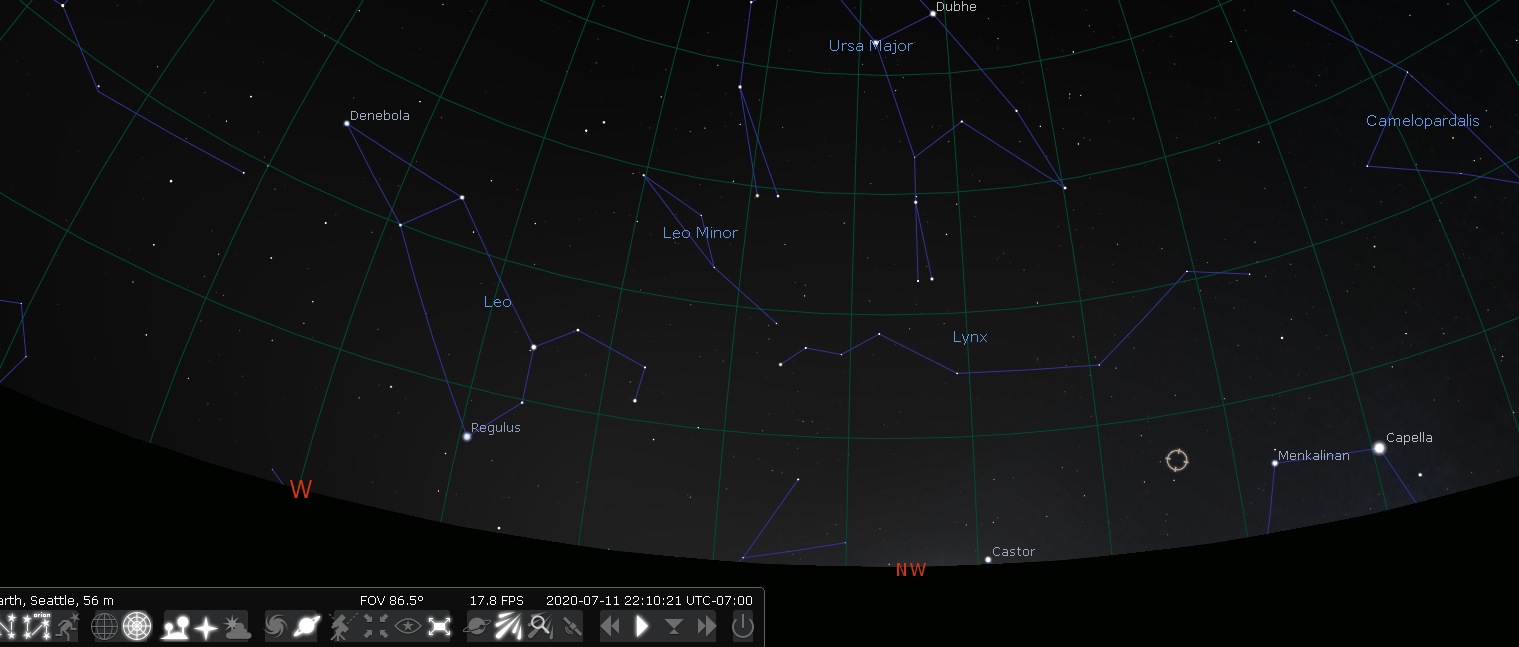
In a few days, after July 12, it will start to be visible after the Sun sets. You’re welcome to try for it before July 12, but since it sets just an hour after sunset, the odds aren’t good. You’ll be looking north of the Northwest horizon.

a Seattle horizon view from Stellarium here for July 11 at 10pm. It will show a small marker next to the Northwest horizon between the constellations of Auriga to the right/North, Ursa Major (the Big Dipper) above, and Leo to the left/South. The marker is about an eighth of the from Auriga to Leo, it is much closer to Leo. It is about a quarter of the way from Auriga to Ursa Major, closer to Auriga

Image from Stellarium

This is a much better horizon from West Seattle, you can view it from most place on the West side of West Seattle. I recommend trying for this one starting July 12 or so, and watch the news to see if other Northern Hemisphere folks have sighted it in their evening skies yet. Wherever you choose, please wear a mask and stay more than 6 feet away from stargazers who aren’t part of your household.

Binoculars

STOP! READ THIS!

If you use binoculars to see this, you must promise me you’ll put them down about 20 minutes before sunrise is predicted to happen. Please. This object is too close to the Sun for me to risk your eyes. Similarly, don’t begin looking for it until at least 5 minutes after you see the Sun finally set below the horizon.

This comet is going to be much more spectacular in binoculars or if you take a long-exposure photograph. A number of phones have “night sight” settings in the camera now, that will also bring out a little more detail, but you’ll need to hold the phone still: rest it on a stable surface.

Any old binoculars will work, they don’t need to be specific to astronomy.

Some useful sources:

  • Sky and Telescope has a map of NEOWISE’s positions over the course of July, and some photos by amateur astronomers.
  • Globe at Night has some reference star charts so you know how bright the stars are that you’re able to see.
  • Earth and Sky has tips on comet viewing, and the picture from Alexander Krivenyshev in Guttenberg, New Jersey is the most like what you’ll see.
  • Aerith.net by Seiichi Yoshida is full of detailed information about this comet, along with its most recent brightness.

Keep Looking Up!

-Alice

Seasonal Sunset Watches!

It’s time for the seasonal sunset watch, every solstice and equinox sunset at Solstice Park in West Seattle. Here are the details for the next several events:

# Date Event Time Actual
Sunset Time
Official
Sunset Time
Equinox/ Solstice Moment Time
41 Summer Solstice 2019
Friday, June 21, 2019
8:30 pm – 9:30 pm 9:00 pm 9:11 pm 8:54 am
42 Fall Equinox 2019
Monday, September 23, 2019
6:30 pm – 7:30 pm 6:55 pm 7:05 pm 12:50 am
43 Winter Solstice 2019
Saturday, December 21, 2019
3:45 pm – 4:45 pm 4:05 pm 4:20 pm 8:19 pm
44 Spring Equinox 2020
Thursday, March 19, 2020WEBCAST VIA ZOOM.
6:30 pm – 7:30 pm


VIA ZOOM.
7:00 pm 7:22  pm 8:50 pm
45 Summer Solstice 2020
June 20, 2020VIA ZOOM, register in advance for this meeting.
8:45 pm – 9:15 pm
VIA ZOOM, register in advance for this meeting.
9:00 pm 9:11 pm 2:44 pm
46 Fall Equinox 2020


Tuesday, September 22, 2020


I will host via Zoom as has become usual.
6:45 pm – 7:15pm


VIA ZOOM!
6:55 pm 7:05 pm 6:31 am
47 Winter Solstice 2020
Monday, December 21, 2020I will host via Zoom as has become usual. Zoom!
3:45 pm – 4:15 pm


VIA ZOOM!
4:05 pm 4:20 pm 2:02 am
48 Spring Equinox 2021


Saturday, March 20, 2021


I will be live-Tweeting during the sunset. Tune in @AlicesAstroInfo
6:45 pm-7:15 pm


ON TWITTER
7:00 pm 7:22 pm 2:37 am
49 Summer Solstice 2021


Sunday, June 20, 2021


VIA ZOOM, register in advance for this meeting.


https://zoom.us/meeting/register/tJYpcuqgrj4pGN0SPUuK7TGLPT3YRgmcqviO
(Twitter will be my backup plan in case of technical difficulties @AlicesAstroInfo)
8:45 pm-9:15 pm


VIA ZOOM!
9:00 pm 9:11 pm 8:31 pm
  • When:

    • We have noticed that the Sun sets about 15 minutes earlier than the USNO‘s official prediction says, because of the horizon altitude.
    • The moment of the solstice/equinox doesn’t usually happen during this event, but I leave it here for you to know.
  • Where: I will host Summer 2021’s Solstice Sunset watch live on Zoom from an undisclosed West Seattle location.

    • I want to support folks in continued social distancing to protect our children and unvaccinated vulnerable folks from SARS-Cov-2/coronavirus.
    • I recommend you find a nice outdoor space to watch the sunset from, and tune in to the participatory webcast for some social interaction and celebration of the turning of the seasons.
    • Please wear a mask and social distance from people until you discuss your combined comfort levels. Some people aren’t ready to give up masks, some people aren’t vaccinated, some people never worried about transmission in an outdoor setting. Let’s be polite and kind as we all navigate each other’s risk tolerances.
  • Where: Solstice Park – all the way up the hill from the tennis courts (or, if you’re not in Seattle, wherever you have a view of the western horizon!)
  • Who: Everyone welcome, as usual. (Please do leash your dogs as we usually have a good number of people, kids, and other dogs around.)
Parent and Child at Sunset by Kazuhiko Teramoto

Parent and Child at Sunset by Kazuhiko Teramoto, skyseeker

Come watch the sunset at Solstice Park in West Seattle. I’ll be there even if it is cloudy because sometimes the Sun peeks through just as it begins to set, but if it is driving rain or a thunderstorm I’m staying home with some tea!

If you’re interested – here’s the timing of various celestial events  from Seattle, courtesy of the U.S. Naval Observatory Astronomical Applications Department.

This event is my part of the NASA’s Solar System Ambassador program, and thanks to West Seattle Blog for publicizing all of them!

Everyone is welcome, see you there!

~ A l i c e !
March 20 Spring Equinox Sunset Watch — 2019

It’s time for the 40th seasonal sunset watch!

40!!!

  • When: Wednesday, March 20, 7:00pm (so come at 6:30pm)

    • Actual sunset is supposed to be at 7:22pm, but we have noticed that the Sun sets about 15 minutes earlier than the USNO says, because of the horizon altitude.
    • The equinox moment is Wednesday, March 20, 2:58pm
  • Where: Solstice Park – all the way up the hill from the tennis courts (or, if you’re not in Seattle, wherever you have a view of the western horizon!)
  • Who: Everyone welcome, as usual. (Please do leash your dogs as we usually have a good number of people, kids, and other dogs around.)
Parent and Child at Sunset by Kazuhiko Teramoto

Parent and Child at Sunset by Kazuhiko Teramoto, skyseeker

Come watch the sunset at Solstice Park in West Seattle. I’ll be there even if it is cloudy because sometimes the Sun peeks through just as it begins to set, but if it is driving rain or a thunderstorm I’m staying home with some tea!

If you’re interested – here’s the timing of various celestial events  from Seattle, courtesy of the U.S. Naval Observatory Astronomical Applications Department:

Sun and Moon Data for One Day

U.S. Naval Observatory
Astronomical Applications Department
Seattle, King County, WA (Longitude W122° 20′, Latitude N47° 38′)

Wednesday, March 20, 2019 Pacific Daylight Time
Sun
Begin civil twilight 6:42 a.m.
Sunrise 7:12 a.m.
Sun transit 1:17 p.m.
Sunset 7:22 p.m.
End civil twilight 7:53 p.m.
Moon
Moonrise 5:47 p.m. on preceding day
Moon transit 12:45 a.m.
Moonset 7:28 a.m.
Moonrise 7:08 p.m.
Phase of the Moon on March 20, 2019: Full Moon at 6:43 p.m. (local daylight time)

This event is my part of the NASA’s Solar System Ambassador program, and thanks to West Seattle Blog for publicizing all of them!

Everyone is welcome, see you there!

~ A l i c e !
December 21 Winter Solstice Sunset Watch — 2018

It’s time for the 39th seasonal sunset watch!

  • When: Friday, December 21, 4:05pm (so come at 3:45pm)

    • Actual sunset is supposed to be at 4:20pm, but we have noticed that the Sun sets about 15 minutes earlier than the USNO says, because of the horizon altitude.
    • The equinox moment is Friday, December 21, 2:23pm
  • Where: Solstice Park – all the way up the hill from the tennis courts (or, if you’re not in Seattle, wherever you have a view of the western horizon!)
  • Who: Everyone welcome, as usual. (Please do leash your dogs as we usually have a good number of people, kids, and other dogs around.)
Parent and Child at Sunset by Kazuhiko Teramoto

Parent and Child at Sunset by Kazuhiko Teramoto, skyseeker

Come watch the sunset at Solstice Park in West Seattle. I’ll be there even if it is cloudy because sometimes the Sun peeks through just as it begins to set, but if it is driving rain or a thunderstorm I’m staying home with some tea!

If you’re interested – here’s the timing of various celestial events  from Seattle, courtesy of the U.S. Naval Observatory Astronomical Applications Department:

Sun and Moon Data for One Day

U.S. Naval Observatory
Astronomical Applications Department
Seattle, King County, WA (Longitude W122° 20′, Latitude N47° 38′)

Friday, December 21, 2018 Pacific Standard Time
Sun
Begin civil twilight 7:19 a.m.
Sunrise 7:55 a.m.
Sun transit 12:08 p.m.
Sunset 4:20 p.m.
End civil twilight 4:56 p.m.
Moon
Moonset 6:30 a.m.
Moonrise 3:52 p.m.
Moon transit 11:43 p.m.
Moonset 7:41 a.m. on following day
Closest Primary Moon Phase: Full Moon on December 22, 2018 at 9:49 a.m. (local standard time)

Phase of the Moon on December 21, 2018: Waxing Gibbous with 99% of the Moon’s visible disk illuminated.

This event is my part of the NASA’s Solar System Ambassador program, and thanks to West Seattle Blog for publicizing all of them!

Everyone is welcome, see you there!

~ A l i c e !
September 19 Fall Equinox Sunset Watch — 2018

It’s time for the 38th seasonal sunset watch!

  • When: Wednesday September 19, 6:55pm (so come at 6:30pm)

    • Actual sunset is supposed to be at 7:13pm, but we have noticed that the Sun sets about 10 minutes earlier than the USNO says, because of the horizon altitude.
    • The equinox moment is Saturday, September 22, 6:54pm
  • Where: Solstice Park – all the way up the hill from the tennis courts (or, if you’re not in Seattle, wherever you have a view of the western horizon!)
  • Who: Everyone welcome, as usual. (Please do leash your dogs as we usually have a good number of people, kids, and other dogs around.)
Parent and Child at Sunset by Kazuhiko Teramoto

Parent and Child at Sunset by Kazuhiko Teramoto, skyseeker

Come watch the sunset at Solstice Park in West Seattle. I’ll be there even if it is cloudy because sometimes the Sun peeks through just as it begins to set, but if it is driving rain or a thunderstorm I’m staying home with some tea!

If you’re interested – here’s the timing of various celestial events  from Seattle, courtesy of the U.S. Naval Observatory Astronomical Applications Department:

Sun and Moon Data for One Day

U.S. Naval Observatory
Astronomical Applications Department
Seattle, King County, WA (Longitude W122° 20′, Latitude N47° 38′)

Wednesday, September 19, 2018 Pacific Daylight Time
Sun
Begin civil twilight 6:21 a.m.
Sunrise 6:52 a.m.
Sun transit 1:03 p.m.
Sunset 7:13 p.m.
End civil twilight 7:44 p.m.
Moon
Moonset 1:15 a.m.
Moonrise 4:56 p.m.
Moon transit 9:31 p.m.
Moonset 2:10 a.m. on following day
Closest Primary Moon Phase: First Quarter on September 16, 2018 at 4:15 p.m. (local daylight time)

Phase of the Moon on September 19, 2018: Waxing Gibbous with 76% of the Moon’s visible disk illuminated.

Sun and Moon Data for One Day
U.S. Naval Observatory
Astronomical Applications Department
Seattle, King County, WA (Longitude W122° 20′, Latitude N47° 38′)

Saturday, September 22, 2018 Pacific Daylight Time
Sun
Begin civil twilight 6:25 a.m.
Sunrise 6:56 a.m.
Sun transit 1:02 p.m.
Sunset 7:07 p.m.
End civil twilight 7:37 p.m.
Moon
Moonset 4:11 a.m.
Moonrise 6:32 p.m.
Moon transit 11:49 p.m.
Moonset 5:14 a.m. on following day
Closest Primary Moon Phase: Full Moon on September 24, 2018 at 7:52 p.m. (local daylight time)

Phase of the Moon on September 22, 2018: Waxing Gibbous with 95% of the Moon’s visible disk.

This event is my part of the NASA’s Solar System Ambassador program, and thanks to West Seattle Blog for publicizing all of them!

Everyone is welcome, see you there!

~ A l i c e !
June 16 Summer Solstice Sunset Watch — 2018

It’s time for the 37th seasonal sunset watch!

  • When: Saturday, June 16 at 8:50pm (so come at 8:30pm)

    • Actual sunset is supposed to be at 9:09pm, but we have noticed that the Sun sets about 10 minutes earlier than the USNO says, because of the horizon altitude.
    • The solstice moment is Thursday, June 21 at 3:07am
  • Where: Solstice Park – all the way up the hill from the tennis courts (or, if you’re not in Seattle, wherever you have a view of the western horizon!)
  • Who: Everyone welcome, as usual. (Please do leash your dogs as we usually have a good number of people, kids, and other dogs around.)
Parent and Child at Sunset by Kazuhiko Teramoto

Parent and Child at Sunset by Kazuhiko Teramoto, skyseeker

Come watch the sunset at Solstice Park in West Seattle. I’ll be there even if it is cloudy because sometimes the Sun peeks through just as it begins to set, but if it is driving rain or a thunderstorm I’m staying home with some tea!

If you’re interested – here’s the timing of various celestial events  from Seattle, courtesy of the U.S. Naval Observatory Astronomical Applications Department:

Sun and Moon Data for One Day

Sun and Moon Data for One Day
U.S. Naval Observatory
Seattle, King County, WA (Longitude W122° 20′, Latitude N47° 38′)
Saturday, June 16, 2018 Pacific Daylight Time
Sun
Begin civil twilight 4:30 a.m.
Sunrise 5:11 a.m.
Sun transit 1:10 p.m.
Sunset 9:09 p.m.
End civil twilight 9:50 p.m.
Moon
Moonrise 8:33 a.m.
Moon transit 4:18 p.m.
Moonset 11:54 p.m.
Closest Primary Moon Phase: New Moon on June 13, 2018 at 12:43 p.m. (local daylight time)
Phase of the Moon on June 16, 2018: Waxing Crescent with 13% of the Moon’s visible disk illuminated.

Sun and Moon Data for One Day
U.S. Naval Observatory
Astronomical Applications Department
Seattle, King County, WA (Longitude W122° 20′, Latitude N47° 38′)

Thursday, June 21, 2018 Pacific Daylight Time
Sun
Begin civil twilight 4:31 a.m.
Sunrise 5:11 a.m.
Sun transit 1:11 p.m.
Sunset 9:11 p.m.
End civil twilight 9:52 p.m.
Moon
Moonset 1:59 a.m.
Moonrise 2:37 p.m.
Moon transit 8:36 p.m.
Moonset 2:24 a.m. on following day
Closest Primary Moon Phase: First Quarter on June 20, 2018 at 3:51 a.m. (local daylight time)

Phase of the Moon on June 21, 2018: Waxing Gibbous with 64% of the Moon’s visible disk illuminated.

This event is my part of the NASA’s Solar System Ambassador program, and thanks to West Seattle Blog for publicizing all of them!

Everyone is welcome, see you there!

~ A l i c e !
March 20 Spring Equinox Sunset Watch — 2018

It’s time for the 36th seasonal sunset watch! (It’s our NINE year anniversary!)

I can’t wait to see you for a reasonably-timed sunset.

  • When: Tuesday, March 20, 2018 at 7:10pm (so come at 6:30/6:45pm)

    • Actual sunset is supposed to be at 7:22pm, but we have noticed that the Sun sets about 10 minutes earlier than the USNO says, because of the horizon altitude.
    • The equinox moment is Tuesday, March 20, 2018 9:15am
  • Where: Solstice Park – all the way up the hill from the tennis courts (or, if you’re not in Seattle, wherever you have a view of the western horizon!)
  • Who: Everyone welcome, as usual. (Please do leash your dogs as we usually have a good number of people, kids, and other dogs around.)
Parent and Child at Sunset by Kazuhiko Teramoto

Parent and Child at Sunset by Kazuhiko Teramoto, skyseeker

Come watch the sunset at Solstice Park in West Seattle. I’ll be there even if it is cloudy because sometimes the Sun peeks through just as it begins to set, but if it is driving rain or a thunderstorm I’m staying home with some tea!

If you’re interested – here’s the timing of various celestial events  from Seattle, courtesy of the U.S. Naval Observatory Astronomical Applications Department:

Sun and Moon Data for One Day

U.S. Naval Observatory
Astronomical Applications Department

Seattle, King County, WA (Longitude W122° 20′, Latitude N47° 38′)

Tuesday, March 20, 2018 Pacific Daylight Time
Sun
Begin civil twilight 6:41 a.m.
Sunrise 7:12 a.m.
Sun transit 1:17 p.m.
Sunset 7:22 p.m.
End civil twilight 7:53 p.m.

Moon
Moonrise 9:07 a.m.
Moon transit 4:02 p.m.
Moonset 11:09 p.m.
Closest Primary Moon Phase: New Moon on March 17, 2018 at 6:12 a.m. (local daylight time)

Phase of the Moon on March 20, 2018: Waxing Crescent with 12% of the Moon’s visible disk illuminated.

This event is my part of the NASA’s Solar System Ambassador program, and thanks to West Seattle Blog for publicizing all of them!

Everyone is welcome, see you there!

~ A l i c e !
December 21 Winter Solstice Sunset Watch–2017

It’s time for the 35th seasonal sunset watch!

I can’t wait to see you for a chilly winter sunset. We’ll also watch for the fingernail-crescent of the Moon just after sunset.

  • When: Thursday, December 21 at 4:05pm (so come at 3:45pm)

    • Actual sunset is supposed to be at 4:20pm, but we have noticed that the Sun sets about 10 minutes earlier than the USNO says, because of the horizon altitude.
    • The equinox moment is Thursday, December 21 at 8:28am
  • Where: Solstice Park – all the way up the hill from the tennis courts (or, if you’re not in Seattle, wherever you have a view of the western horizon!)
  • Who: Everyone welcome, as usual. (Please do leash your dogs as we usually have a good number of people, kids, and other dogs around.)
Parent and Child at Sunset by Kazuhiko Teramoto

Parent and Child at Sunset by Kazuhiko Teramoto, skyseeker

Come watch the sunset at Solstice Park in West Seattle. I’ll be there even if it is cloudy because sometimes the Sun peeks through just as it begins to set, but if it is driving rain or a thunderstorm I’m staying home with some tea!

If you’re interested – here’s the timing of various celestial events  from Seattle, courtesy of the U.S. Naval Observatory Astronomical Applications Department:

Sun and Moon Data for One Day

U.S. Naval Observatory
Astronomical Applications Department

Seattle, King County, WA (Longitude W122° 20′, Latitude N47° 38′)

Thursday, December 21, 2017 Pacific Standard Time
Sun
Begin civil twilight 7:19 a.m.
Sunrise 7:55 a.m.
Sun transit 12:08 p.m.
Sunset 4:20 p.m.
End civil twilight 4:56 p.m.
Moon
Moonrise 10:09 a.m.
Moon transit 2:56 p.m.
Moonset 7:48 p.m.
Closest Primary Moon Phase: New Moon on December 17, 2017 at 10:30 p.m. (local standard time)

Phase of the Moon on December 21, 2017: Waxing Crescent with 11% of the Moon’s visible disk illuminated.

This event is my part of the NASA’s Solar System Ambassador program, and thanks to West Seattle Blog for publicizing all of them!

Everyone is welcome, see you there!

~ A l i c e !